

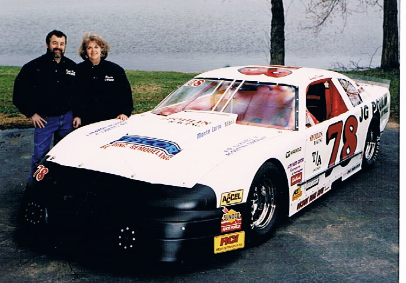
Welcome Back to the 78- Poulin Web Site!! We worked hard to get this site back to being "ours" soon
it will be filled with many years of memories... stayed tuned.....
In the News 78-Poulin Racing
For those of you who may have accessed
our site during the last year and found material that was not related to our racing history, we provide the following results
of a successful lawsuit that was filed with the World Intellectual Property Organization Arbitration and Mediation Center.
The internet is a wonderful place, but 20 years ago it was a new world, and we entered that new arena innocently,
in good faith, not realizing that once a name is entered into that world, it lives on forever. If thru any series of
omission, a website is not renewed, [in our case thru no fault of our own], that name goes into a netherland and can be pickup
by others for a very low cost for use in what is called _pay-per-click_ [PPC].
It has taken a great deal
of time, effort and money, to recoup necessary historical documents and regain control of our website name and in the eyes
of many who have accidentally accessed us in the past 14 months, to regain control of our good name.
So to all
who endeavor to start a website----Beware. Choose your domain host carefully. Be aware of renewal dates,
do not depend on billing, be certain that you can reach domain host not only thru email but live voice.
WIPO Arbitration and Mediation Center
ADMINISTRATIVE PANEL DECISION
Brigitte Poulin, Jean-Guy
Poulin v. Ggot, Ltd.
Case No. D2010-0834
1. The Parties
The Complainants are Brigitte Poulin and Jean-Guy Poulin both of Hartford Connecticut, United States of America, represented
by Lott & Friedland, PA, United States of America.
The Respondent is Ggot, Ltd. of Budapest, Hungary.
2. The Domain Name and Registrar
The disputed domain name <78-poulinracing.com>
is registered with GoDaddy.com, Inc.
3. Procedural History
The Complaint was
filed with the WIPO Arbitration and Mediation Center (the “Center”) on May 24, 2010. On May 25, 2010, the
Center transmitted by email to GoDaddy.com, Inc. a request for registrar verification in connection with the disputed domain
name. On May 25, 2010, GoDaddy.com, Inc. transmitted by email to the Center its verification response confirming that
the Respondent is listed as the registrant and providing the contact details. The Center verified that the Complaint
satisfied the formal requirements of the Uniform Domain Name Dispute Resolution Policy (the “Policy” or “UDRP”),
the Rules for Uniform Domain Name Dispute Resolution Policy (the “Rules”), and the WIPO Supplemental Rules for
Uniform Domain Name Dispute Resolution Policy (the “Supplemental Rules”).
In accordance with the Rules,
paragraphs 2(a) and 4(a), the Center formally notified the Respondent of the Complaint, and the proceedings commenced on May
28, 2010. In accordance with the Rules, paragraph 5(a), the due date for Response was June 17, 2010. The Respondent
did not submit any response. Accordingly, the Center notified the Respondent’s default on June 18, 2010.
The Center appointed Nicholas Weston as the sole panelist in this matter on June 24, 2010. The Panel finds that it
was properly constituted. The Panel has submitted the Statement of Acceptance and Declaration of Impartiality and Independence,
as required by the Center to ensure compliance with the Rules, paragraph 7.
Language
The language of
this administrative proceeding is English, being the language of the registration agreement.
4.
Factual Background
The Complainants operate a business involving the promotion, marketing and merchandising of
a racing car team under the name and trademark POULIN RACING in the United States (“USA”). The Complainants
are the owners of two unregistered trademarks POULIN RACING and 78 POULIN RACING which they have used to identify their racing
cars in the USA since 1990. They own the domain name <poulinracing.com> registered on March 31, 2009 and operate
a website relating to its car racing business at that domain name. They previously owned the domain name <78poulinracing.com>
and operated a website relating to their car racing business at that domain name from 1999. They also owned the domain
name <78-poulinracing.com> (the “Disputed Domain Name”) and operated a website relating to their car racing
business at that domain name from August 2000.
The Respondent registered the Disputed Domain Name <78-poulinracing.com>
on March 30, 2009.
The Respondent uses the Disputed Domain Name for a “click-through” or “pay-per-click”
(“PPC”) web page. PPC advertising is a marketing technique for directing traffic to a web page containing
sponsored links or sponsored advertisements. In this case, when the Disputed Domain Name <78-poulinracing.com>
is typed in, it redirects traffic to a PPC web page for pornography.
5. Parties’
Contentions
A. The Complainants
The Complainants cite their unregistered trademarks
via use since 1990 of the words POULIN RACING and 78 POULIN RACING in the promotion, marketing and merchandising of a car
racing team that participates in NASCAR® stock-car racing which, the evidence indicates, is a class of motor vehicle racing
that is widely known in the USA, as prima facie evidence of ownership.
The Complainants submit that the unregistered
marks POULIN RACING and 78 POULIN RACING are distinctive and that their rights in these marks predate the Respondent’s
registration of the Disputed Domain Name <78-poulinracing.com>. They submit that the Disputed Domain Name is confusingly
similar to their trademark, because the Disputed Domain Name incorporates in its entirety the POULIN RACING trademark, or
alternatively the 78 POULIN RACING trademark, and that the similarity is not removed by the omission of a space between the
words “poulin” and “racing” (citing Banca Intesa S. p.A v. Roshan Wickramaratna, WIPO Case No. D2006-0215).
The Complainants contend that the Respondent has no rights or legitimate interests in respect of the Disputed Domain
Name because the Respondent has no trademark rights in or license to use the POULIN RACING mark.
Finally,
the Complainants allege that the registration and use of the Disputed Domain Name was, and currently is, in bad faith, pursuant
to the Policy, paragraphs 4(a)(iii) and 4(b) and the Rules, paragraph 3(b)(ix)(3). On the issue of registration, the
Complainants contend that it was registered in bad faith because the Disputed Domain name “is derived from Complainants’
family name and has no pornographic or explicit connotation” (citing Caledonia Motor Group Limited v. Amizon,
WIPO Case No. D2001-0860). On the issue of use, the Complainants contend that “Respondent is using the disputed
domain name to redirect Internet users to explicit adult pornographic material [and that by doing so] Respondent is exploiting
Complainants’ trademarks, and trading on the goodwill created by Complainants’ trademarks, for its own financial
gain”. In this case, when the Disputed Domain Name <78-poulinracing.com> is typed in, it resolves to a web
page containing pornography and links to pornography.
B. Respondent
The Respondent
did not reply to the Complainants’ contentions. However, the Complainants’ evidence is that on April 10,
2010 (prior to the filing of the Complaint with the Center on May 24, 2010) the Respondent replied to the Complainants’
cease and desist communication as follows: “My name is Paul Muranyi, I’m the current owner of this domain.
I’m ready to sell it for you, for a reasonable price. Currently it makes about $80-$100 income monthly of the
advertisements in the footer. Please make your offer for buying it back.”
6.
Discussion and Findings
Under paragraph 4(a) of the Policy, the Complainants have the burden of proving the following:
(i) that the Disputed Domain Name is identical or confusingly similar to a trademark or service
mark in which the Complainants have rights; and
(ii) that the Respondent has no rights
or legitimate interests in respect of the Disputed Domain Name; and
(iii) that the Disputed
Domain Name has been registered and is being used in bad faith.
A. Identical or Confusingly
Similar
The Complainants have produced sufficient evidence to demonstrate that they have unregistered trademark
rights in the mark POULIN RACING in the United States. In light of the undisputed evidence provided by the Complainants,
the Panel finds that the Complainants have established that the names POULIN RACING and 78 POULIN RACING have achieved secondary
meaning or association with Complainants (see: Uitgerverij Crux v. W. Frederic Isler, WIPO Case No. D2000-0575;
Australian Trade Commission v. Matthew Reader, WIPO Case No: D2002-0786; Universal City Studios Inc. v. David Burns
and Adam-12 Dot Com, WIPO Case No.D2001-0784). It is undisputed that the Complainants have been identifying their car
racing business with the POULIN RACING and 78 POULIN RACING marks since 1998 and that their business is widely known and distinctive
to a wide audience of those interested in NASCAR® stock-car racing. Also undisputed are the Complainants’
claims to have used their personal name “Poulin” together with the word “racing” as a marketable commodity,
for direct commercial purposes in marketing their own goods or services and this Panel finds that they do have what appears,
prima facie, to be a sufficient reputation in the name to establish common law passing off which, other panels have found,
can establish common law trademark rights (see: Julia Fiona Roberts v. Russell Boyd, WIPO Case No. D2000-0210;
Dr. Michael Crichton v. In Stealth Mode, WIPO Case No. D2002-0874; Israel Harold Asper v. Communication X Inc., WIPO
Case No. D2001-0540; Chinmoy Kumar Ghose v. ICDSoft. com and Maria Sliwa, WIPO Case No. D2003-0248; WIPO Overview
of WIPO Panel Views on Selected UDRP Questions paragraph 1.6).
Turning to whether the Disputed Domain Name
is identical or confusingly similar to the POULIN RACING or 78 POULIN RACING trademarks, the Panel observes that the Disputed
Domain Name comprises (a) an exact reproduction of the Complainants’ trademark 78 POULIN RACING containing (b) a “dash”
between the number “78” and the words “poulin racing”, then followed by (c) the top level domain suffix
“.com” all in one continuous domain name.
It is well-established that the top-level designation used
as part of a domain name should be disregarded: (see Magnum Piering, Inc. v. The Mudjackers and Garwood S. Wilson, Sr.,
WIPO Case No. D2000-1525; Rollerblade, Inc v. Chris McCrady, WIPO Case No. D2000-0429; Phenomedia AG v. Meta Verzeichnis
Com, WIPO Case No. D2001-0374). The relevant comparison to be made is with the second-level portion of the Disputed
Domain Name: “78 poulin racing”.
It is also well-established that where a domain name incorporates
a complainant’s well-known and distinctive trademark in its entirety, it is confusingly similar to that mark despite
the addition of a word or, in this case, the “dash” between the number “78” and the words “poulin
racing”: (see Oki Data Americas, Inc. v. ASD, Inc., WIPO Case No. D2001-0903; Wal-Mart Stores, Inc. v. Kuchora,
Kal, WIPO Case No. D2006 0033; CVS Pharmacy, Inc. and CVS Vanguard, Inc. v. gd, WIPO Case No. D2004-0113;
Hoffmann-La Roche Inc. v. Andrew Miller, WIPO Case No. D2008-1345).
This Panel finds that the omission of
a space between the word “poulin” and the word “racing” does not serve to adequately distinguish the
Disputed Domain Name which therefore remains confusingly similar to the registered trademark: (see: Banca Intesa
S. p.A v. Roshan Wickramaratna, supra).
The Respondent’s email to the Complainants indicates that
it is using the Disputed Domain Name for commercial purposes and is deriving click-through revenue from advertising.
In considering the elements of paragraph 4(a) of the Policy, the contents of a website - which is the direct manifestation
of the potential uses of the domain name -are typically not relevant. In Arthur Guinness Son & Co. (Dublin) Limited
v. Dejan Macesic, WIPO Case No. D2000-1698, the panel held that “[t]he use to which the site is put has no bearing upon
the issue whether the domain name is confusingly similar to the trademark, because by the time Internet users arrive at the
Website, they have already been confused by the similarity between the domain name and the Complainants’ mark into thinking
they are on their way to the Complainants’ Website”. The Disputed Domain Name is therefore confusingly similar
to the 78 POULIN RACING trademark.
Accordingly, the Panel finds that the Complainants
have established the first element of paragraph 4(a) of the Policy.
B. Rights or Legitimate
Interests
Paragraph 4(c) of the Policy lists the ways that the Respondent may demonstrate rights or a legitimate
interest in the Disputed Domain Name:
(i) before any notice of the dispute, the Respondent’s
use of, or demonstrable preparations to use, the Disputed Domain Name or a name corresponding to the Disputed Domain Name
in connection with a bona fide offering of goods or services; or
(ii) the Respondent (as
an individual, business or other organization) has been commonly known by the Disputed Domain Name, even if it has acquired
no trademark or service mark rights; or
(iii) the Respondent is making a legitimate noncommercial
or fair use of the Disputed Domain Name, without intent for commercial gain to misleadingly divert consumers or to tarnish
the trademark or service mark at issue.
The Policy places the burden on the Complainants to establish the absence
of the Respondent’s rights or legitimate interest in the Disputed Domain Name. Because of the inherent difficulties
in proving a negative, the consensus view is that the Complainants need only put forward a prima facie case that the Respondent
lacks rights or legitimate interests. The evidential burden then shifts to the Respondent to rebut that prima facie
case (see: World Wrestling Federation Entertainment, Inc v. Ringside Collectibles, WIPO Case No. D2000-1306; WIPO
Overview of WIPO Panel Views on Selected UDRP Questions, paragraph 2.1).
The Complainants contend that the Respondent
has no rights or legitimate interests in respect of the Disputed Domain Name because the Respondent has no trademark rights
in or license to use the POULIN RACING or the 78 POULIN RACING marks. The Respondent’s email to the Complainants
neither confirms nor denies whether he is authorized or licensed to use the POULIN RACING mark and there is no evidence that
the Respondent is commonly known by the Disputed Domain Name. The Respondent’s name as reflected in the registrar’s
WhoIs database is Ggot Ltd, not POULIN RACING or 78 POULIN RACING. The issue is not whether the Respondent has any rights
or legitimate interests in the trademark 78 POULIN RACING. Rather, the issue is whether the Respondent has any rights
or legitimate interests in the Disputed Domain Name, for example by making the bona fide offering of a product or service
called “78 POULIN RACING”.
The Complainants provided evidence (in the form of screen captures, Exhibit
C) that typing in the Disputed Domain Name diverts traffic to a website with pornographic content and links. Pornography,
click-through revenues, parked sites, aggregation or resale of domain names, and Internet revenue from advertising are none
of them per se illegitimate under the Policy, but that fact alone does not give the Respondent the unqualified right to appropriate
a trademark belonging to someone else, for such activities. The evidence is that typing in the Disputed Domain Name
misleadingly directs Internet users to a webpage composed of PPC links and thereby attempts illegitimately to trade for commercial
gain and with the purpose of capitalizing on the fame of the Complainants’ mark 78 POULIN RACING. In MatchNet
plc v. MAC Trading, WIPO Case No. D2000-0205, for example, the panel found that it is not a bona fide offering of goods or
services to use a domain name for commercial gain by attracting Internet users to third party sites offering sexually explicit
and pornographic material.
The Respondent’s email to the Complainants does not appear to allege the
existence of any rights or legitimate interests as per paragraphs 4(c)(ii) or (iii) of the Policy. The Respondent neither
contends that it is making a bona fide offering of goods or services, or that it is commonly known by the Disputed Domain
Name, or alternatively, that it is making a legitimate noncommercial or fair use of the domain name.
While
the linking of domain names to pornographic websites can constitute bona fide offerings of services for the purposes of paragraph
4(c)(i) (see: The Perfect Potion v. Domain Administrator, WIPO Case No. D2004-0743) that decision turned on the
lack of evidence to support that the respondent had heard of the complainant’s trademark when it had adopted the disputed
domain name for its own website. In Angus Sholto-Douglas, Kwandwe Private Game Reserve v. Sergey Fedorov, WIPO Case
No. D2006-1184, the panel found that “the Respondent undoubtedly had knowledge” of the complainant’s trademark,
since the complainant had registered and used the disputed domain name whose registration the complainant had mistakenly allowed
to lapse, and the respondent immediately hijacked the domain name. This case is sufficiently similar, in the absence
of any evidence to the contrary, to form the same conclusion.
The Panel finds for the Complainants on the second
element of the Policy.
C. Registered and Used in Bad Faith
The third element of the Policy that the
Complainants must also demonstrate is that the Disputed Domain Name has been registered and used in bad faith. Paragraph
4(b) of the Policy sets out certain circumstances to be construed as evidence of both.
“b.
Evidence of Registration and Use in Bad Faith. For the purposes of Paragraph 4(a)(iii), the following circumstances,
in particular but without limitation, if found by the Panel to be present, shall be evidence of the registration and use of
a domain name in bad faith, (relevantly):
i. you have registered the domain name in order to
prevent the owner of the trademark or service mark from reflecting the mark in a corresponding domain name, provided that
you have engaged in a pattern of such conduct; or
ii. you have registered the domain name
primarily for the purpose of disrupting the business of a competitor; or
iii. by using
the domain name, you have intentionally attempted to attract, for commercial gain, Internet users to your web site or other
on-line location, by creating a likelihood of confusion with the complainant’s mark as to the source, sponsorship, affiliation,
or endorsement of your web site or location or of a product or service on your web site or location.”
The
examples of bad faith registration and use in paragraph 4(b) are not exhaustive of all circumstances from which such bad faith
may be found; (see: Telstra Corporation Limited v. Nuclear Marshmallows, WIPO Case No. D2000-0003). The
objective of the Policy is to curb the abusive registration of domain names in circumstances where the registrant is seeking
to profit from and exploit the trademark of another. (See: Match. com, LP v. Bill Zag and NWLAWS. ORG, WIPO Case
No. D2004-0230).
The Respondent does not admit or deny actual knowledge of the Complainants’ activities,
trademark or its secondary meanings at the time of the registration. Rather, the Respondent appears to be indifferent
to such rights and simply describes himself as the “current owner”, stating in his email of May 24, 2010: “My
name is Paul Muranyi, I’m the current owner of this domain. I’m ready to sell it for you, for a reasonable
price. Currently it makes about $80-$100 income monthly of the advertisements in the footer. Please make your
offer for buying it back.” A simple Internet search would have revealed the Complainants’ interest in the 78 POULIN
RACING mark. There is no evidence that the Respondent had reasonable grounds to give the warranty under paragraph 3
of the GoDaddy Parked Page Service Agreement that “You have no knowledge of infringing upon or conflicting with the
legal rights of a third party or a third party’s trademark or trade name”. Paragraph 2 of the Policy clearly
states: “It is your [domain-name holder’s] responsibility to determine whether your domain name registration
infringes or violates someone else’s rights”. The lack of any good faith attempt to ascertain whether or
not he was registering and using someone else’s trademark, may support a finding of bad faith: (see: Mobile
Communication Service Inc. v. WebReg, RN, WIPO Case No. D2005-1304; mVisible Technologies Inc. v. Navigation Catalyst
Systems, Inc., WIPO Case No. D2007-1141).
The Respondent’s use of the Disputed Domain Name is apparently
for domain monetization unconnected with any bona fide supply of goods or services by the Respondent. The PPC business
model in this case, is that the Respondent passively collects click-through revenue generated solely from the Complainants’
goodwill and Internet users’ inaccurate guessing of the correct domain name associated with the Complainants’
78 POULIN RACING stock-car driving team, such guessing made harder in this case by virtue of the Complainants prior ownership
and use of the Disputed Domain Name. Exploitation of the reputation of a trademark to obtain click-through commissions
from the diversion of Internet users is a common example of use in bad faith as referred to in paragraph 4(b)(iv) of the Policy
and identified in many previous decisions. (See: L’Oréal, Biotherm, Lancôme Parfums et Beauté
& Cie v. Unasi, Inc, WIPO Case No. D2005-0623; Veuve Cliquot Ponsardin, Maison Fondée en 1772 v. The
Polygenix Group Co., WIPO Case No. D2000-0163 and Hoffmann-La Roche Inc. v. Samuel Teodorek, WIPO Case No. D2007-1814).
In addition, the Respondent’s inclusion of advertising links for pornography on the website hosted at the
Disputed Domain Name potentially creates the false impression that the Complainants might have endorsed content of that nature.
Regardless of whether Internet users would know that the Complainants and their trademarks are not connected with pornography,
the Respondent has used the Complainants’ trademarks to attract unwitting Internet users (see National Spiritual Assembly
of the Bahá’ís v. Buy This Name, WIPO Case No. D2001-1302). Numerous panels have previously found
that when a disputed domain name associates a distinctive trademark with pornography, such use provides additional evidence
of bad faith (see: Ty Inc v. O. Z. Names, WIPO Case No. D2000-0370; Barry Diller v. Internetco Corp.,
WIPO Case No. D2000-1734; AltaVista Company v. Alt Pile Co., WIPO Case No. D2002-0933; Six Continents Hotels,
Inc. v. Seweryn Nowak, WIPO Case No. D2003-0022).
Moreover, the Respondent’s email confirms that it is not
only directly profiting from the use of Complainants’ marks, but also makes the suggestion that it will sell the Disputed
Domain Name to the Complainants for valuable consideration in excess of its out-of-pocket costs. Both of these behaviours
reinforce a finding of bad faith.
This Panel finds that the Respondent has taken the Complainants’ trademark
78 POULIN RACING and incorporated it in the Disputed Domain Name without the Complainants’ consent or authorization,
for the very purpose of capitalizing on the reputation of the trademark by diverting Internet users to a PPC web page containing
pornography and links to pornography for commercial gain.
Accordingly, the Panel finds that the Complainants
have satisfied the requirements of paragraph 4(a)(iii) of the Policy.
7. Decision
For all the foregoing reasons, in accordance with paragraphs 4(i) of the Policy and 15 of the Rules, the Panel orders
that the domain name <78-poulinracing.com> be transferred to the Complainant, Brigitte Poulin, as requested in the Complaint.
Nicholas Weston Sole Panelist
Dated: July 8, 2010
 |

 |